Wednesday, 30 July 2014

Day 3 - Nara


Nara City, a UNESCO World Heritage Site, was the first permanent capital of Japan. Being the central of administration and religion for almost a century, it had spawned many unique properties; each represents compelling reasons for traveler to explore. The free-roaming deer around the vast greenery of Nara Park and Mount Wakakusa seems to have tailor-made for natural-lover. Various Buddhist temples and a Shinto shrine which stood firm until modern era since 8th century will intrigue not only historical enthusiasts, but also photographers or even religious pilgrims.

Private Rail - Kintetsu Railway (Kintetsu Nara Line) and JR (Yamatoji Line) have frequent departure from Osaka-Namba Station, reaching Kintetsu-Nara station in about 40 minutes. The fastest train - Rapid Express cost JPY 560, other train cost the same but has more stops (hence longer traveling time).

I took the Kintetsu Railway directly to the heart of the city - Kintetsu Nara Station where Nara Park is a mere 10 minutes walk (JR brings you to the farther Nara Station, which is 20 - 30 minutes walk ). I only plan to explore Nara Park as a fair share of attractions are clustered around it. Spending a day there was more than enough to cover Kokfuku-ji, Todai-ji, Nara National Museum, Kasuga Taisha, Isui-en Garden and many more. Many of these sites forms part of UNESCO World Heritage - "Historic Monuments of Ancient Nara".

The Exit of Kintetsu Nara Station. Just walk straight from the station and you will reach Nara Park soon.

A bronze statue in front of Kintetsu Nara Station

The walk to and within Nara Park was extremely pleasant. Tame Silka deer are basically roaming everywhere within the park. You can go as near as touching these beautiful creatures and they won't shun away. Legend said that these deer has divine affiliation and therefore are left untouched in the park. You can even buy the Deer Cracker from the omnipresent cracker stall and feed them. If you are close to them, they will just come and grab it from you. I did wonder how does it taste but was warned by a signboard of a stall that "it taste good for deer, but bad for human!". It was a shame that I did not try to feed the deer, and I recommended one does.

Deer resting in front of one of Nara Park entrance
Kofuku-ji (temple) is the nearest temple from Kintetsu-Nara Station. This temple complex has a large wooden hall and a tall pagoda. The hall is adequately merit for a few snap shots and the pagoda is rather breathtaking for its height, albeit not as beautiful as Toji (temple) in Kyoto (which I will describe in the latter post). Not bad to start the journey here, serving as a warm up for something more magnificent afterwards. Admission for temple ground is free.

Kofukuji Main Temple Complex


Deer resting nearby Kofukuji

Waiting for food? At the back is the Deer Cracker stall.

The main highlight is Toda-ji (The Great Eastern Temple). The moment I pass through the main gate, what presented in my eyes was simply awe-inspiring despite the view was flooded by a mixture of human-deer crowd. Perhaps the largest wooden structure in the world, this behemoth main hall is flanked by two vast, impeccably manicured lawn which further enhance my admiration of it. At the cost of JPY 500, you can also experience the largest Buddha Bronze Statue within the main hall.


The path towards the main gate

Todaji

Nearby the main hall is the Nigatsu-do (February Hall). Not as fascinating as the main hall, it is less crowded but offered a more peaceful experience. The smaller hall is on top of a hill which one can climb up to the verandah. The serenity of the surrounding can be a sanctuary for immense relaxation, or perhaps meditation.
Nigatsu-do

Nigatsu-do, view taken from the hall verandah.

Next was Mount Wakakusa was the terminus of my sightseeing trip. Looking from its base, it is an unforgettable sea of greenery slope where visitor can climb up the hill by paying JPY 150. It was the perfect place for resting, with the fine view acted as a catalyst of inner calmness. On the other side, there are a few souvenir shops and eateries, quite crowded by elementary school children on a field trip.
Mount Wakakusa from base

A shopping street with Mount Wakakusa as background


My next and last destination is Kasuga-Taisha Shrine (The Shrine of Spring). It was a 30 minutes passage through the inner section of Nara Park, resembling to a "return to past" sort of journey. It does sound cliche but the whole trip was completely shielded from the sound of urban mechanics, leaving just chirping of birds and uncanny insect noise. This shrine is famous for its stone lanterns, either on the narrow pathway around the temple ground or along the roof of the building corridor. Exhaustion kicks in when I reached there and I only briefly strolled by. Outer area is free and it cost JPY 500 to enter the main hall. 

The stone lantern of Kasuga-Taisha Shrine


A group of deer nearby the shrine

Column of Bronze Lantern

I proceeded for lunch afterwards in a Kaiten Sushi (Conveyor Belt Sushi) at Higashimuki Shopping Street, which is just in front of the Kintetsu Nara Station. This boulevard is rather touristy, where most theme of handicrafts and souvenirs are deer-based.

One last look at the park

Interesting signboard warning "potential threat" of a deer

The quiet shopping street - picture taken in the morning.

There are more temples, a National Museum and gardens around Nara Park which only can be covered by additional stamina. Horyuj (temple) complex and Former Imperial Palace - Heijo deserve a dedicated excursions, which I recommend and wish to visit some day. 

In fact, omitting the above mentioned temples etc, Nara is still a concrete jungle without the spectacular architecture artistic and this is a blessing in disguise. A stroll in the less touristy part of city provided a more local outlook. It was the usual - commuters in and out of local train station, folks shopping at local supermarkets, school children munching tidbits on the way back home. I always love to look at these seemingly mundane activities, probably because it whispers a sense of closeness. Less excitement is a virtue, urging one to slow down their pace to simply experience life.

Tuesday, 29 July 2014

Day 2 - Osaka

Foreign visitor to Osaka is eligible to purchase Osaka Day pass which enable you to visit 28 sight seeing facilities for free, including the popular Umeda Sky Building and Osaka Castle. It is also comes with free unlimited usage of subways and buses. 1 day pass cost JPY 2,300 while 2 days pass cost JPY 3,000. It is highly recommended for tourist who plan to visit 3 or more of the tourist attraction covered by the pass.

Since my priority at Osaka is the Castle and shopping, I ignored it.

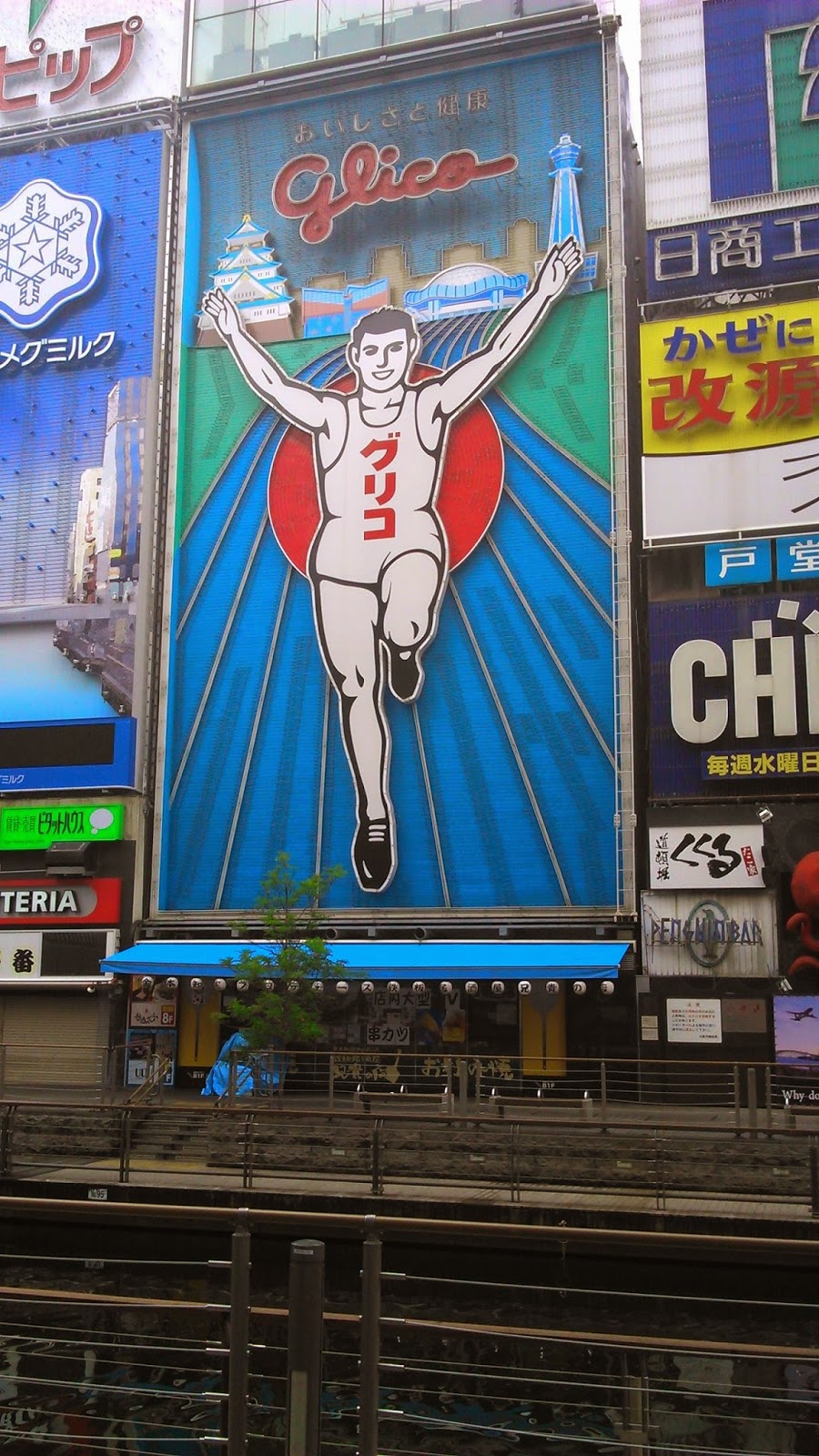
I missed the infamous Glico Man neon signboard on the previous night. First thing to do on Day 2 after breakfast was to find it. 

Located near Ebisu bridge along the Dotonbori canal, here it is:


Unfortunately,  it is not as spectacular as night but morning is the best timing to get a clear picture without the crowd. Morning stroll along the canal was a rewarding experience as well. 

My next stop is Osaka Castle. It is around 5 minute walk from the subway to Tannimachi 4-chome station. This massive castle was constructed in the 16th century, destroyed and reconstructed several times. It is now erected in the centre of a massive park famous for its cherry park and surrounded by an outer and inner moat. The castle building is now converted into a museum telling the rise and fall of the castle as well as its founder and subsequent occupants. Its top floor is the observatory deck. Entrance fees costs JPY 600. 


Osaka Castle Park walk way towards its main entrance.

Outer moat of the castle park


Otemon gate - entrance to the inner moat

Sakuramon gate - entrance to the main castle complex
Self-explanatory - the massive castle building
Small field of flower nearby the castle complex.

Unfortunately, it started to rain after lunch. I have no choice but to spend the afternoon in Namba Walk. It is a long underground shopping arcade spanning two subway station i,e. Namba station and Nihhonbashi Station. 


Monday, 28 July 2014

Day 1 - Osaka


Getting to Osaka from Kansai International Airport
There are a few options to travel into the heart of Osaka:

1) Private rail Nankai Airport Express cost JPY 920 can get you to Namba under 50 minutes.
2) Private rail Nankai Airport Limited Express Rapi:it cost JPY 1,430 is a faster alternative within 37 minutes.
3) JR Kansai Airport Rapid Service cost JPY 1,190 can get you to Osaka Station in 70+ minutes
4) JR Haruka Limited Express cost JPY 3,050 can get you to Shin-Osaka just under 50 minutes.

Namba is the main shopping district where Dotonbori and Shinshaibashi is within the vicinity, If you have a JR pass, you can use the JR Haruka Limited Express and change station at JR Tennoji station to JR Namba station for free.

Arrived at Kansai International Airport around 4pm. Located on a man-made island, this airport is well sign-posted in English. One can easily locate the tourism counter and train station. Maps are available at the tourism counter stationed by English-speaking Japanese lady who greets you with a warm “Welcome to Japan”.
I bought the ICOCA-Haruka rail pass* at the JR West office just in front of the entrance of train station. Staff speaks limited English but I have no problem in getting the pass smoothly. 


The Haruka Limited express ticket. You will be issued with 2 tickets for each trip if you bought the round-trip version. 


ICOCA rechargeable contactless smart card with Osaka Castle and Hello Kitty as cover art. 


Train ride to Osaka was a peaceful journey. I whisked through the quiet suburban on a Sunday evening  there’s no traffic congestion & hustle-bustle of human activity. Just the scene of occasional local folks riding their bicycle or strolling serenely nearby the train tracks portraying a lazy Sunday evening. 


The peaceful Izumisano suburb just outside Kansai Airport.


I spent the night at Dotonbori, a large shopping arcade which has a fair share of exciting eateries with over-the-top signboard. The experience here was completely different than the train ride just now. Packed with people doing their last minute chill out before enduring Monday blue, it is as lively as morning rush hour with less intensity. Here, it was a perfect appetiser in my trip to get a glimpse of urban culture in Japan. 

Scenes of Dotonbori street

Scenes of Dotonbori street

One of the restaurants with giant dragon as signboard.

The famous crab restaurant with of course, a giant mechanised crab signboard.

*ICOCA-Haruka pass includes a return ticket from Kansai International Aiport to either Osaka, Kyoto and Kobe and a pre-charged with JPY 1,500 ICOCA smart card. Your arrival station from the airport need not to be same as your departure station to airport as long as it is within the Osaka, Kyoto and Kobe zone. It cost JPY 4,060 for round trip or JPY 3,030 for single trip. 

Day 0 - Introduction


It is hard to challenge Kansai region as the historical heart of Japan. It houses two former capital of Japan for over a millennium. It is boasted with 5 UNESCO Heritage Sites, numerous architecture and art master pieces designated as “National Treasure” by Japanese Government. I discovered these facts in 2013, which inspired me to start researching about the region, obviously targeting it as my next traveling destination in subsequent year.

I do not wish to provide free advertisement for Air Asia, but this budget airline makes the trip possible. With a return ticket from Kuala Lumpur to Osaka (Kansai Airport) for less than RM 700 (USD 230), it is akin to an offer I can’t refuse. The next thing I need to do then is to start panning and saving!

The itinerary

Intrigued by Nara and Kyoto due to its statuses as both UNESCO Heritage Sites and former capital of Japan, my trip was focused on these two.  Caused by time-constraint, I reluctantly abandon a detour to Himeji (famous for its Japan’s largest Himeji Castle) and Kobe (Beautiful Port city with plenty of shopping opportunities).

Day 1: Osaka – Arrival in the evening. Spend the night at Dotonbori. 
Day 2: Osaka - Osaka Castle, Namba walk and Shishaibashi Shopping Arcade.  
Day 3: Nara - Nara Park and its surrounding (Kofukuji Temple, Taodaiji Temple, Nigatsudo Hall, Kasuga Taisha Wakasuka hill and Higashimuki Shopping Street.
Day 4: Kyoto – Kiyomizu-dera, Ginkaku-ji, Kinkaku-ji & Ryoanji.
Day 5: Kyoto – Nijo-jo, Nishiki Market & Hoganji Temples
Day 6: Kyoto – Kyoto Imperial Palace & Shopping at Kyoto Station
Day 7: Kyoto – Toji Temple and head to Kansai Airport.

I arranged my itinerary in a loop (i.e. Osaka – Nara – Kyoto – Osaka) to avoid spending additional on returning ticket and the fuss of catching the train back. 

Rail passes

Visitors traveling to Kansai region are both blessed and cursed with numerous money-saving rail and bus passes offered by JR, private rails and local municipality. It takes effort and time to study the pros and cons these passes in order to extract the best deal out of it.

I have dedicated a post for a detailed analysis on this matter. Feel free to have a look.